Are you a mom? Have you pursued motherhood? Do you want to live more intentionally, more purposefully, recognizing that your calling as a mother is a chance to change the world?
There is one week left to get The Pursuit of Motherhood half price!
Are you a mom? Have you pursued motherhood? Do you want to live more intentionally, more purposefully, recognizing that your calling as a mother is a chance to change the world?
There is one week left to get The Pursuit of Motherhood half price!
Their naps fall right at cleaning up from lunch and wrapping up morning school stuff, and right before a full afternoon, squeezing all the life out of it I can.
“Will you tell me a story about a horse that poops butterflies?” Her sweet smile begs.
He wants one about monster trucks. Again.
I was busy. I tell lots of stories. Today I needed to hurry and do…
more important stuff.
And I knew instantly, though she didn’t complain, what I was about to miss.
It’s the thousand small things in a day–the tiny, rhythmic motions that assure a child all is well, life is sure and steady.
It’s my choice to value our short story time as much as the other things, to tell her, by my stopping, that this–she–is the more important stuff.
Don’t we like to think that parenting greatness comes in big, lofty moments? That would be easier. But everything good happens slowly, steadily, growing almost imperceptible over time, through the ignoble, and it’s no different growing people. Maybe that’s why fewer and fewer are signing up for full time parenthood.
Simple. But excruciatingly hard.
And whether it’s telling a nap time story, waiting patiently for a shoe-tying rookie, or putting the broom down because my teenager needs to talk, if I rush through it, or neglect it altogether so I can be “on to bigger things”, I’ve missed the bigger things already.
“We cannot do great things on this earth. We can only do little things with great love.” -Mother Teresa
“My kids go to public school but I’m really interested in homeschooling and I was wondering if maybe you guys could answer some questions for me?
Do you ever feel bad about your kids missing out on things like marching band, choir, clubs, high school sports, the prom, and graduation?” -Tonya
This was actually one of my initial concerns when we were considering homeschooling. And like so many other fears, I’ve come to realize it’s partly a result of our own conformity to a way of life, and associated peer pressure.
The first answer is that homeschoolers don’t miss out. Their options for extracurricular activities far exceed those of a child limited by time restraints of school. Depending on what families choose, many can even participate in school sports, put together their own proms, have bands, clubs, graduation and more.
Many parents considering homeschooling somehow think his child is the only one and will be alone in his journey. They quickly realize, though, that they are part of a huge, rapidly growing community, with more people, activities and opportunities than they will ever be able to join. (There are currently more than 2,010,198 children being homeschooled in America.)
Secondly, once a family steps out of the “school culture” they realize how empty many of the peer-dominated activities were and are thankful the pressure is off.
Youth is a fabulous time of growing, learning and experiencing life. Homeschooling affords more time and availability to pursue interests a young person would otherwise be too busy for. As parents adapt to a [homeschooling] world they never knew existed, missing the prom or the marching band becomes a trivial, can’t-believe-I-ever-worried-about-that, non-issue, replaced by more productive, meaningful opportunities.
I think about how this played out for me personally, and the contrast I can now see as a homeschooling parent of teenagers. As both a cheerleader and later a cheerleader sponsor, I experienced the inordinate amount of time we spent doing something that, well, doesn’t prepare for life. Yeah the team work thing, but that can be easily gained in a normal family setting, if we weren’t so busy with our extra curriculars.
At one point in high school, we were required–in addition to all day practices–to spend Sunday decorating lockers for Homecoming. (Because that’s important.) My Dad felt like it was inappropriate and I told my sponsor that. I’ll never forget my *Christian* cheer-leading sponsor grabbing me by the front of my shirt, pulling me right into her eyes and saying through gritted teeth, “You decide if cheer-leading or a family rule is more important.”
Now that I’m a parent, I’m so grateful for the time my older children have to pursue more meaningful activities, still maintaining close friendships and enjoying fun events, but spending the bulk of time doing more productive, real life things–learning to run businesses, honing their talents and gifts, learning to serve the community.
I would encourage all parents to carefully consider whether we are steering our children towards activities that are productive, useful and tending to growth and preparation, or if we, too, are being swayed by a peer pressure of our own, tricked into thinking they’ll “miss out” if we don’t follow main stream.
“If we would only consider the subtle strengthening of ties which comes from two people reading the same book together, breathing at once its breath and each giving the other unconsciously his interpretation of it, it would be seen how, in this simple habit of reading aloud, lies a power too fine to analyze, yet stronger than iron in welding souls together. To our thinking, there is no academy on earth equal to that found in so many homes, of a mother reading to her child.” Elisha Schudder, The Riverside Magazine for Young People
Reading is good, everyone knows that. It enriches your thought life, aids your reasoning, enhances your communication, and in general, educates the mind.
But what if that is only the beginning?
A Family Program for Reading Aloud provokes me to think that maybe reading aloud to my children is more beneficial to our relationship than even their education.
Here’s another excerpt from the book:
“American Christian parents began to lose control over their children when they relinquished home-reading aloud. As they turned over the education of their children to outside agencies, even to the Sunday School and to the Christian School, they lost a critical part of their intimate relationship with their children. Many wonderful teachers have gained by what parents let go–yet parents alone have opportunities which are never afforded to those outside the realm of home.”
Consider that Jesus said, “A good man out of the good treasure of his heart brings forth what is good…out of the abundance of the heart his mouth speaks.” Luke 6:45
Home was once the place where hearts could be filled with “good treasure”, and reading played a significant part in that. Good literature was an integral part of the Christian home and the formation of character depended much on parents reading and instilling the love of reading in their children.
If we relinquish our commitment to intentionally form the mind and hearts of our children toward what is good and noble, we give it to someone else–other influences and voices fighting for their allegiance.
It seems almost old fashioned to talk about rekindling the practice of reading aloud as a family, because I fear our digital age is an unintentional enemy of that fundamental habit of gathering together, all our faculties focused on the same story, our attention directed and unified toward a common theme.
Read to your children. If you do nothing else, read to them. Reading to them will grow your hearts together, enlarge their imaginations, plant something wonderful in their memories and gradually refine their characters as they turn into men and women.

My recent post on Facebook seemed to be a favorite, so I thought I’d share it here.
I ran into a sweet mom of 4 today. She told me that all she hears is “You’re done now, right?”
For those of you who say that to moms with more than 2, what does that mean? And why do you say it? And would it change your response if you knew that we hear that all. the. time.? And how would you feel if almost everyone you ran into asked, “Why don’t you have more children?”
And what does it imply of God’s created design?
That He forgot the cut off switch? That He just expected that we would *know* only 2 children are normal and after that if we don’t take destructive, body-altering drugs, known to have all sorts of side effects, then we deserve the comments meant to imply our apparent ignorance?
Why is natural so en vogue in almost every other area, but is virtually insane as it applies to reproduction? Do we even notice that we have let cultural expectations dictate what we call “normal”? It’s normal to have the babies God gives you. But the few who do are treated like misfits. It’s almost like making fun of people who don’t have tattoos. I’m OK with your tattoo. But I’m not a freak because I don’t have one. You made a deliberate decision to get one. It didn’t just show up one day.
In a normal marriage, and if God has opened the womb, babies will show up unless you deliberately prevent them. That’s OK if you want to. I’m not going to ask you why or imply your family is too small or that you must hate your children since you didn’t have more. But it would be so awesome if others would show the same courtesy. And even better, that other Christians would speak the language of Scripture when it comes to children.
Do you know what Rebekah’s marriage blessing was?
“May you be the mother of thousands and ten thousands, and let your children possess the gates of those who hate them.”
Is that the way we talk to young newlyweds? (Most often I think it goes something like, “Don’t get pregnant too soon.”)
God spoke of children–not just the first two–as wealth and prosperity, blessing and inheritance. The modern church ignores a lot of what the Bible says, but perhaps nothing as much as what it has to say about children. It makes me scratch my head a lot, I guess because, as a mom of 10, I’m sort of a “catch all” for the opinions of others about fertility. It makes me sad. Not me personally, not because of how much rudeness or misunderstanding I have to endure, but because of the impotence of the church as a result of our misguided beliefs about children.
God’s intentions were that we would not only love children for the sake of loving them, but that we would understand as He gives us each child, commands us to make a disciple of that child, we cooperate with Him in one of the primary and profound means of spreading the gospel. (Malachi 2:15 “He desires a godly lineage.”)
That generally, godly children would be the obvious fruit of a Christian marriage, and that would cause the enemy to quake. At the VERY least, a Christian who understands this, would rejoice when other Christians have babies, not make them feel like freaks. I’ve never seen reactions to children in the Bible like the ones we get so often. When the Hebrews were in bondage under slavery in Egypt, do you know what God gave them? More babies. (They couldn’t afford them, by the way.) I’m just challenging God’s people….where are we getting our cues about how to think?
And I may be meddling now, but I so long to see pastors return to a biblical view of children from the pulpit. It is your business, and it would revolutionize the church.
Moore Family Films sent us ABC Say it With Me Bible Memory Verses, and my children so enjoyed watching it! The DVD is unique in that it not only teaches a Bible verse that corresponds with each letter of the alphabet, but also has the Moore family reenact a short lesson from the Bible.
As we seek to help our children hide God’s Word in their hearts, this resource is an excellent tool!
If you order now you can get FREE SHIPPING on all orders! (Some restrictions apply)
Visit Moore Family Films to see all of their products.
Take a peek:
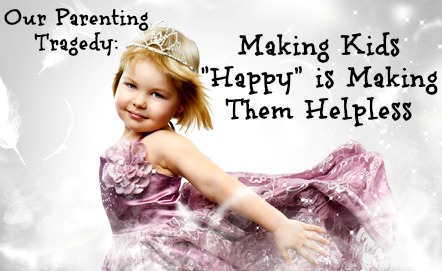
Of course we want our kids to be happy. We love them. We want good things for them. The problem is, what we often think is good for them isn’t; and what we think will make them happy, in the long run, doesn’t.
Published this week at the Huffington Post, was one of the best, honest articles I’ve read in a while about modern parenting and the dilemma we are facing. Are We Raising a Generation of Helpless Kids? outlines a few major things parents have done wrong, resulting in not happy kids, but helpless kids who are having a hard time making it in life. A closer look at the now-grown Generation Y tells the story.
“These well-intentioned messages of ‘you’re special’ have come back to haunt us,” Elmore says. “We are consumed with protecting them instead of preparing them for the future. We haven’t let them fall, fail and fear. The problem is that if they don’t take risks early on like climbing the monkey bars and possibly falling off, they are fearful of every new endeavor at age 29.”
Parents who raised Generation Y (a.k.a. “millennials”) told them they were special, for no reason. They didn’t have to demonstrate good character or persevere, or excel at anything to be rewarded. Just show up. You know, we didn’t want to hurt their feelings. And now, they demand the same treatment from employers and spouses.
That generation was raised with helmets, knee pads and injury law suits. They were bathed in hand-sanitizer and hovered over by over-protective, fearful parents who raced to the school to defend Johnny’s “right” to express himself even if violates dress code. They were even given birth control “just in case.” At all cost, avoid failure, injury or consequence.
And while none of us would choose hardship for ourselves or our children, if we understood how healthy it can be we could relax and walk through it, instead of going to such great lengths to avoid it.
As I hear constantly, for the number one reason why people don’t want more children, “we can’t afford it”, what most parents mean is, they want to make their children happy and that involves buying stuff, giving them things, taking them places, involving them in activities, giving them “enough attention”, and generally living a lifestyle that, in reality, can not abide more children. This, they think, is what good parents do to ensure their children are happy.
This is precisely, according to psychologists, what is making children neurotic as they enter adulthood, quite the opposite parents were going for.
Ironically, as our family has gone through seasons of “can’t afford it”, and by that I mean electricity, as unpleasant as it is, I can look back and see the real, life-long advantages of enduring hardship (and really hardship is relative). And I can say with confidence, it’s good for children–for all of us–to be denied, to go without, to suffer, to be forced to rely on God for our daily needs.
As we grow children to be equipped to take on life, the real kind that throws curve balls and will challenge them to go beyond themselves, sometimes a great deal beyond, we don’t need to be concerned about whether we’re able to buy enough gadgets so our kids will fit in. We need to be concerned about raising kids who know how to dig their heels in because they’ve had to. Kids who know how to solve problems creatively because creativity was sometimes all they had. We need kids who connect consequence with choice from their own experience, painful as that can be. And we need, more than anything, to raise children who live for something bigger than themselves, even willing to sacrifice personal comfort and desires for that purpose.
We need to stop lying to ourselves and each other about what really makes kids happy in the long run. We need to resurrect the reality that hardship can teach invaluable lessons and stop trying to safeguard against every impediment to our obsession with immediate gratification.
This is how we love our children…stand with them, thick or thin, feast or famine, rain or shine, protecting them from the things we should, but not shielding them from the realities of life that teaches them how to grow up. Let’s raise capable kids.
GET 10 SECRETS TO RAISING HAPPIER KIDS HERE!

Yes, life-changing. The following list, all rooted in Scripture, takes deliberate, faithful teaching, but will pay big dividends in the lives of your children.
1. not be easily offended. Luke 6:29 speaks of turning the other cheek when slapped. The principle here is, love is not easily provoked and covers a multitude of sins. Don’t get your feelings hurt easily. If your are the recipient of a mild injustice, don’t nurse it. Let it go. You will be healthier, your relationships will be stronger and things will go much better for you.
2. focus on what is right instead of what is wrong in their lives–gratitude. We all have the choice to dwell in the negative or focus on the positive. While that may sound trite, the power of choosing gratitude can not be overstated. One potentially thriving person pines his life away in crippling bitterness because he can’t let go of injustices done to him which are out of his control. Another, dealt enormous obstacles in life, chooses gratitude and his obstacles become a boon to him instead of a hindrance.
3. take responsibility. It’s very easy to blame others for our failures or mistakes. Some children are experts at the blame game. We need to carefully help them examine themselves and not fall prey to shifting blame and avoiding responsibility for their actions. Failure to pass this on to our children will be the source of tremendous hardship for them in life.
4. hold other’s opinions lightly, finding their worth in their identity in Christ. We all too easily crave the praise of man more than the praise of the Father. Children, especially, can let others’ opinions of them become an idol, influencing their choices or hindering their confidence in their uniqueness. Parents can even be guilty of placing wrong emphasis on external traits and accomplishments rather than internal worth. Helping our children find their identity and acceptance in the Lord is one of the most important things we can do for them.
5. do their work diligently. “One who is faithful in a very little is also faithful in much…” Teaching young children to do a job diligently will lay the foundation for their worldly success later in life. While it most certainly takes more time and effort to call a child back to redo a job, the work will pay off in huge dividends. We need to encourage our children to be thorough, to see even the smallest tasks as Kingdom work when they are doing their work as to the Lord and not unto man. We need to remind them that Scripture urges us to be diligent and that obedience to that will make an enormous difference in our lives, whatever we set our hands to do.
Keep up the good work. We are planting an eternal garden.
There are plenty of reasons, inscribed in articles everywhere, not to have children. Things like “poop, sleeplessness, hectic trips to Disney World and giving up a thousand freedoms.” And of course, “to have more time and energy left for the dogs.”
Those things are true. In fact, there’s a never-ending list of things children cost a parent.
But all costs aren’t equal. I’ve noticed most of the reasons to not have children hover in the “now” and are relatively shortsighted. There are expenses and there are investments. The temporary expense of children pales in comparison to the value of their investment.
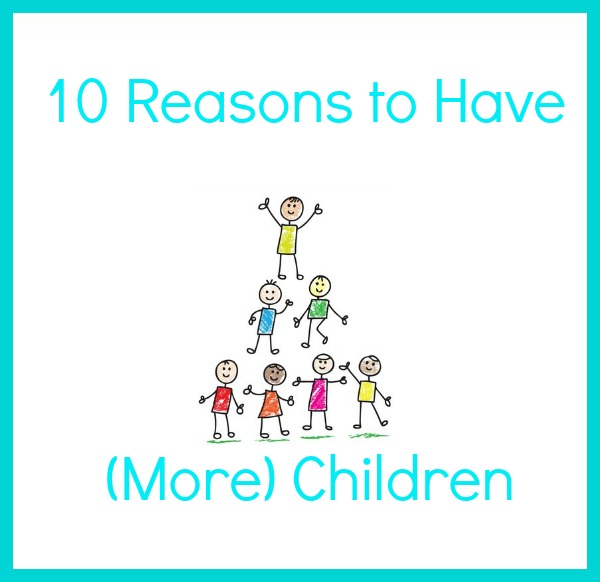
So I offer you 10 reasons to have more children:
1. Companionship. They’re a barrel of fun when they’re young, and as they get older, they become your best friends (if you’re investing in them). Has anyone ever wished they had fewer best friends?
2. They share the load of life. Whether it’s emptying the dishwasher, or sharing the grief of a lost loved one, more is better, every time.
3. Each one changes you. Every child in a family has a remarkably unique personality. I could never have guessed how different 10 children from the same family could be. But the difference in each personality meets yours at a different place and refines you, grows you, expands you.
4. Children give you vision. Whether it’s thinking about tomorrow or ten years from now, children force you to look ahead and make better decisions about your today with their tomorrow in mind.
5. They take you outside of yourself. Every time a sweet-smelling newborn has been placed in my arms for the first time, it’s like the first time. The realization that a new, incredible, helpless human has been placed in our care is overwhelming and important. There is no love like parent love and the more we must live outside of our own cares, the better, I think.
6. They show us the world. Life loses its real meaning without the fresh awe and wonder of children. Children teach us to see the good in people, to forgive easily, to let a sunset thrill our senses. They make us kinder and teach us to appreciate simplicity. Each new child that comes along refreshes our perspectives all over again.
7. They keep you from watching TV. TV is fine sometimes, and I like watching it. But it also takes up a lot of time we could be talking or reading or helping someone or making something. And it bombards us with ads for things we don’t need and desensitizes our faculties. A full house keeps us too busy and too entertained by little ones to watch it and I’m grateful.
8. You get lots of gifts on holidays. And that’s fun.
9. As they get older, the investment returns. Whether its monetary, emotional, physical or spiritual, a family works like a body. When one part needs something, the others help compensate. We’re connected, and we all thrive or not depending on how we contribute and take care of each other. It starts in small ways–older ones pitch in for gas, insurance, food. But it may end up with adult children pouring into the lives of their older parents, just as those parents poured into their children.
10. You get to partner with the Creator of the universe, becoming a vessel through which the love between husband and wife becomes flesh, and a one-of-a-kind, fresh, new idea of God, full of possibilities is placed in your arms, positively soft and beautiful and captivating and unbelievable. A thing you could never do too many times.
Too important to include in a list, the all-encompassing reason to have children, for Christians at least, is to make disciples and expand the Kingdom through the first, natural means given to us. More than just propagating a civilization, we propagate an army for Him.
We must take responsibility for our part in the culture of death in which we now live, or be hypocrites, as we ponder the atrocity that is Planned Parenthood. We didn’t just wake up in a place where killing babies was an option better than having them. When birth control became accepted, it became expected. We essentially said we wanted to not have babies when we didn’t want babies, but we still want to take part in the act of how they are made. And with us being all in control now, an “unplanned pregnancy” became a tragedy.
Worse, we projected that expectation onto everyone else. “Don’t have babies too soon after marriage” (they will hinder you)…”Don’t have babies too close together” (they will inconvenience you)…”Don’t have too many babies” (they will cost you), and by our narrow allowance, babies–people, immortal human life, simultaneously, were devalued.
When the stigma is strong enough, the criticism loud enough, and the value of one’s own comfort exceeds the value of a new life, abortion is the second and obvious line of birth control. We can do our part, as Christians, esteeming and valuing every life, by echoing God’s Word, instead of the culture’s voice.
People get really squirmy when the topic of birth control comes up and I can attest, having studied and written on the subject for almost 7 years, there are few hotter button topics.
I’ve been begged to leave the subject alone, reminded that it’s “an issue solely between husband, wife and God.” And it is. But the ripple effect goes far beyond that, and it’s that effect I’m so concerned about, among Christians, which is why I keep tackling the topic.
Some beg for the lives of the innocent at their local abortion mill. And some beg with words, agonizing during the night, rushing to find a keyboard.
I have believed, and will continue to unless I’m convinced otherwise, that there is a short walk between the birth control mindset and abortion.
Hear what I said: “the birth control mindset.” This is a very important distinction. I am not saying, nor have I ever said, it is a sin to prevent or space children, upon careful prayer and discernment, within the proper understanding of life. It’s not a discussion about specific circumstances, or sick mamas or hard pregnancies.
The “birth control mindset” is one that treats new life too lightly, fails to give proper authority to the Creator, assumes absolute control over fertility and consequently establishes (either consciously or not) that the idea of “normal” family size is two or three children.
The birth control mindset inadvertently becomes hostile to the practice of forgoing birth control. And herein lies a great problem.
To the church I say: we cannot be staunch pro-life advocates only where abortion is concerned. It is hypocritical to fight for the life of the unborn, but insult the life of the born (and the mother who gave him life), where we deem his birth order to be too high. That is as good as saying, “you should have aborted those last three.”
You might say, “no, she should have prevented the last three.”
Which could be said to every mother walking into an abortion clinic. But her birth control simply failed. Yet we still clamor for that child’s life, and rejoice to see it spared. And we should. Just as we should celebrate every life, especially the life of a believer, receiving into his family the very heritage of the Lord.
Here are my reasons for believing there’s a strong connection between birth control and abortion:
“The connection between contraception and abortion is primarily this: Contraception facilitates the kind of relationships and even the kind of attitudes and moral character that are likely to lead to abortion. The contraceptive mentality treats sexual intercourse as though it had little connection with babies; it thinks of babies as an “accident” of intercourse, as an unwelcome intrusion into a sexual relationship, as a burden. The sexual revolution has no fondness – nor room for – the connection between sexual intercourse and babies…” –Professor Janet Smith,”The Connection Between Contraception and Abortion“
Planned Parenthood vs. Casey:
“…the recent Supreme Court decision that confirmed Roe v. Wade, stated, “in some critical respects abortion is of the same character as the decision to use contraception… for two decades of economic and social developments, people have organized intimate relationships and made choices that define their views of themselves and their places in society, in reliance on the availability of abortion in the event that contraception should fail.” (emphasis mine)
Janet Smith again writes:
“To support the argument that more responsible use of contraceptives would reduce the number of abortions, some note that most abortions are performed for “contraceptive purposes.” That is, few abortions are had because a woman has been a victim of rape or incest or because a pregnancy would endanger her life, or because she expects to have a handicapped or deformed newborn. Rather, most abortions are had because men and women who do not want a baby are having sexual intercourse and facing pregnancies they did not plan for and do not want. Because their contraceptive failed, or because they failed to use a contraceptive,they then resort to abortion as a backup. Many believe that if we could convince men and women to use contraceptives responsibly we would reduce the number of unwanted pregnancies and thus the number of abortions. Thirty years ago this position might have had some plausibility, but not now. We have lived for about thirty years with a culture permeated with contraceptive use and abortion; no longer can we think that greater access to contraception will reduce the number of abortions. Rather, wherever contraception is more readily available the number of unwanted pregnancies and the number of abortions increases greatly.”
Judith Bury, coordinator of Doctors for a Woman’s Choice on Abortion said:
“There is overwhelming evidence that … the provision of contraception leads to an increase in the abortion rate.”
Dr. Walter Larimore, who for decades prescribed the pill, tried to disprove the claim that the pill is abortifacient, only to find 94 scientific studies proving that “postfertilization effects are operative to prevent clinically recognized pregnancy.” He published his findings in the scientific journal of the American Medical Association, and from then on stopped prescribing the pill.
Why it matters so much
Christians must think carefully and discern wisely about reproduction and fertility. To simply adopt the culture’s practices of such an important, world-changing activity, without due attention to God’s directives, is not only unwise, but potentially destructive.
Where God said:
Margaret Sanger, Planned Parenthood & Pro-Choice Advocates said:
(So What if Abortion Ends a Life, Mary Elizabeth Williams)
Before we can hope to see abortion eradicated and life embraced as sacred–sacred enough to protect, preserve and defend at all costs, all life must become so.
If the birth control mindset causes us to measure the value of a child’s life by the number of children born before him, we do not share the mind of God, and deserve the consequences of sharing the mind of a culture who defends death.
We cannot mock what God has created and called good, while simultaneously claiming to be pro-life. As long as we do, we needn’t wonder why abortion is such a vile blight on our society.
Facebook
Twitter
Youtube
Instagram
Copyright ©2023 Generationcedar. All Right Reserved. Designed and Developed by Duke